What the RBA is actually trying to do with interest rates — and why prices won't fall
HouGarden Australia, 7 October — The question circulating on Australian social media was blunt: if inflation means prices are higher, does the RBA expect businesses to start cutting prices to bring inflation down? And if businesses never permanently cut prices, how does inflation actually get fixed?
The answer begins with a fact that surprises many people: the RBA does not want zero inflation. Its official target is for consumer prices to rise by 2.5 per cent every year on average. If prices are rising faster than that, the RBA acts to slow them. If they are rising more slowly, it acts to speed them up.
In practice, that means prices that have already risen are not coming back down. If consumer prices rise by 2.5 per cent this year, again next year, and again the year after, the cumulative effect is a price level that is permanently higher after three years. That is not a flaw in the system — it is the intended design.
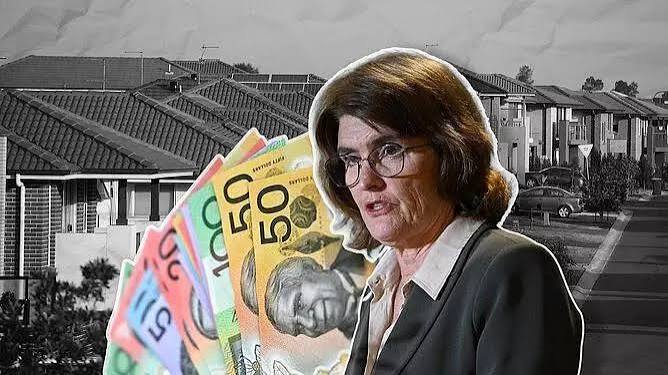
RBA Governor Michele Bullock has acknowledged that Australian consumer prices have risen by between 20 and 25 per cent over the past few years. She has said publicly that those prices will not return to their previous, lower levels. What she wants instead is for prices to rise much more slowly for a period — back toward the 2.5 per cent annual target.
To illustrate how the price level actually behaves over time, consider a simple price-level graph rather than the rate-of-change chart published by the Australian Bureau of Statistics (ABS). A price-level chart shows a line that always slopes upward when the economy is growing, stepping up sharply in periods of high inflation and more gradually when inflation eases. The ABS chart, by contrast, shows the rate of change — a line that can fall even while prices themselves are still rising. That presentation requires readers to work through several analytical steps, and it is easy to mistake a falling line for falling prices.
The ABS data, plotted as a price level, tells a clear story. Prices stepped up sharply in 2022 and 2023, when inflation accelerated significantly. The pace of increases then slowed through 2024, easing enough for the RBA to cut rates three times in 2025, according to the scenario laid out in the source analysis. In late 2025 and into 2026, the analysis projects prices stepping up noticeably again, which it says has prompted the RBA to lift rates once more. It is important to note that this 2025–2026 timeline is a forward-looking scenario described in the original reporting, not a confirmed sequence of events.
Using a five-year comparison, the analysis shows that if Australian consumer prices had continued rising at the 2014-to-2019 pace, they would be about 8.85 per cent higher than they were five years ago. Instead, according to the ABS figures cited in the report, they are currently around 24 per cent higher. That 24 per cent figure is what the RBA is referring to when it says price growth needs to return to a less disruptive pace.
The RBA acknowledges it cannot control every source of inflation. Higher fuel costs driven by overseas conflict and food and insurance price shocks linked to climate events are largely beyond its reach. But it is still raising interest rates to tighten financial conditions, slow economic activity, and — the RBA says this explicitly — push unemployment slightly higher, so that local businesses lose the pricing power needed to lift prices by more than 2.5 per cent a year.
The central bank acknowledges it risks triggering a recession by taking that approach, but considers the action necessary.
The core point is this: the RBA is not trying to force businesses to cut prices. It is trying to engineer conditions in which businesses stop raising prices so quickly. Once that distinction is clear, the logic of rate decisions — and the reason everyday prices remain stubbornly high even after rates move — becomes considerably easier to follow.